ChangeGear Service Desk is a comprehensive solution that enables IT support staff to quickly and easily respond to customer requests. Designed using the ITIL best practices framework and Microsoft .NET platform, ChangeGear Service Desk tracking and an integrated architecture.With ChangeGear Service Desk, IT support staff can:Accelerate incident and problem resolutionAttain 360-degree visibility into service support processesGain ITIL compliance out-of-the-boxChangeGear Service Desk is comprised of a Self-Service Portal, Incident Management and Problem Management
for more information
Click on the following link
http://www.sunviewsoftware.com/products/servicedesk.aspx?gclid=CO78hoaMrJECFShsGgodUAIEfw
Showing posts with label ITIL. Show all posts
Showing posts with label ITIL. Show all posts
Monday, February 4, 2008
Monday, November 5, 2007
10 automation companies to watch
RealOps
Virtugo Software
Opsware
Opalis
mValent
NetworkAutomation
Enigmatec
FastScale
BladeLogic
Aveksa
want to read more on the above companies and there tools in automation. Please click on the links below.
http://www.networkworld.com/news/2007/062507-automated-companies-to-watch.html?page=1
Virtugo Software
Opsware
Opalis
mValent
NetworkAutomation
Enigmatec
FastScale
BladeLogic
Aveksa
want to read more on the above companies and there tools in automation. Please click on the links below.
http://www.networkworld.com/news/2007/062507-automated-companies-to-watch.html?page=1
Tuesday, October 9, 2007
Good White Paper on Capacity Management by Microsoft
Capacity Management Overview
The Capacity Management SMF helps organizations achieve and sustain the IT service capacity requirements they need to support their business at a justifiable cost. For the purposes of this document, the term “capacity” is one of convenience, which, depending on the context, may imply resource capacity, such as storage, processor speed, network, or human resources, or an end-to-end IT service capacity, such as messaging, customer relationship management (CRM), or order processing. Many of the principles and suggestions for best practices still apply regardless of the type of capacity being optimized.
Capacity management is made up of three subprocesses:
• Business capacity management (BCM)
• Service capacity management (SCM)
• Resource capacity management (RCM)
These subprocesses all share a common set of activities that are applied from different perspectives. They include the following:
• Modeling
• Service monitoring
• Performance management
• Demand management
• Workload management
• Analysis
• Change initiation
• Optimization
• Trend analysis
Each of these subprocesses works toward the production and maintenance of a capacity plan and triggers requests for change through the appropriate channel. These activities all support the proper management of resources and service performance levels in order to conform to current and anticipated business requirements.
to read the full white paper please click on the link below -
http://www.microsoft.com/technet/solutionaccelerators/cits/mo/smf/smfcapmg.mspx#ESF
The Capacity Management SMF helps organizations achieve and sustain the IT service capacity requirements they need to support their business at a justifiable cost. For the purposes of this document, the term “capacity” is one of convenience, which, depending on the context, may imply resource capacity, such as storage, processor speed, network, or human resources, or an end-to-end IT service capacity, such as messaging, customer relationship management (CRM), or order processing. Many of the principles and suggestions for best practices still apply regardless of the type of capacity being optimized.
Capacity management is made up of three subprocesses:
• Business capacity management (BCM)
• Service capacity management (SCM)
• Resource capacity management (RCM)
These subprocesses all share a common set of activities that are applied from different perspectives. They include the following:
• Modeling
• Service monitoring
• Performance management
• Demand management
• Workload management
• Analysis
• Change initiation
• Optimization
• Trend analysis
Each of these subprocesses works toward the production and maintenance of a capacity plan and triggers requests for change through the appropriate channel. These activities all support the proper management of resources and service performance levels in order to conform to current and anticipated business requirements.
to read the full white paper please click on the link below -
http://www.microsoft.com/technet/solutionaccelerators/cits/mo/smf/smfcapmg.mspx#ESF
OPNET’s Application Performance Management (APM) solutions

OPNET’s Application Performance Management (APM) solutions ensure that applications will perform effectively in production, that systems have adequate capacity to support them, and that networks that deliver application functionality can meet service level objectives.
Capacity Planning and Design solutions by OPNET

OPNET's Capacity Planning and Design solutions leverage OPNET's unique virtual network environment, which provides an ideal venue for infrastructure planning. The virtual OPNET model accurately captures the behavior of networks, applications, and servers, allowing organizations to pro-actively provision the infrastructure to meet performance and availability requirements of new and existing applications and services.
for more information click on the link below -
BMC TM Application Response by BMC MANAGED SERVICES
The BMC TM Application Response Time Monitoring Service uses real application transactions
to quantify the end user experience — can even report differences due to geography, network
and user type. The BMC TM Application Response Time Monitoring service can monitor a wide array of applications and protocols — over 60 in all. We can also consolidate all application availability and performance data collected into a single centralized database and Web portal, so you can report on your complete enterprise. Gain a complete and holistic view of your performance, rather than one application/customer/data center at a time.
for more information click on the link below -
http://documents.bmc.com/products/documents/87/90/58790/58790.pdf
to quantify the end user experience — can even report differences due to geography, network
and user type. The BMC TM Application Response Time Monitoring service can monitor a wide array of applications and protocols — over 60 in all. We can also consolidate all application availability and performance data collected into a single centralized database and Web portal, so you can report on your complete enterprise. Gain a complete and holistic view of your performance, rather than one application/customer/data center at a time.
for more information click on the link below -
http://documents.bmc.com/products/documents/87/90/58790/58790.pdf
Wednesday, September 5, 2007
Web-based Business Service Dashboards
The assystBSM Web Client delivers an integrated view, or "Dashboard" representing real-time and historical end-to-end Business Service availability, performance, security, and end-user experience. Regardless of the underlying technologies and management platforms deployed throughout your organization, assystBSM provides vital service health information direct to your Web browser, providing support staff with the ability to rapidly identify service impacting technology failures, understand their business impact, and zoom in to the failing object level. Immediate access to tools, online help, procedures, and automation scripts is provided via context sensitive launching to restore service fast.


for more information click on the link below -
Wednesday, August 22, 2007
Argent Predictor
The Argent Predictor is a comprehensive capacity planning, trend analysis and reporting solution. While monitoring the rate of consumption of critical resources, the Argent Predictor is able to produce graphs and analysis from any data source including disk space, CPU utilization, SQL log sizes, Exchange and IIS usage. Monitoring and truly understanding the workload a system is capable of handling in a given period of time allows the meeting of current and future demands with minimal surprises. The Argent Predictor analyzes long-term movement, allowing more effective planning for the future. The Argent Predictor also provides Service Level Agreements so that the efficiency and uptime of critical devices such as servers, hubs and routers can be rated to better support business units.
Completely Integrated With The Argent Guardian
Advanced Features Make The Argent Predictor Unique
 For more information click on the link below -
Key Features And Benefits
Built-in Service Level Agreement ReportingThe Argent Predictor provides powerful and flexible Service Level Agreement reports and graphs, showing the reliability and efficiency of critical servers and devices - their uptime and reliability over a period of days, weeks, or months.
Built-in Service Level Agreement ReportingThe Argent Predictor provides powerful and flexible Service Level Agreement reports and graphs, showing the reliability and efficiency of critical servers and devices - their uptime and reliability over a period of days, weeks, or months.
Select The Database That Best Fits
The Argent Predictor saves capacity planning data to a customer's SQL Server, Oracle, or any ODBC database.
Completely Integrated With The Argent Guardian
The Argent Predictor is fully integrated with the rest of Argent's product line - there is no learning curve for users.
Advanced Features Make The Argent Predictor Unique
The Argent Predictor has a large number of extremely powerful advanced features such as Automatic Report Distributions, Calendaring, and advanced 2D and 3D graph customization. Quick Reports are available, providing "executive level" web-based reports. Reports are automatically generated and can be emailed, exported, or uploaded into a designated FTP site at pre-defined times.
Fully Customizable Under Crystal Reports
The Argent Predictor's graph templates interface directly with Crystal Reports, providing the ability to customize reports in various ways, such as adding company headers and logos, and modifying layouts.
For more information click on the link below -Sunday, August 19, 2007
ALERTIT
ALERT has been specifically designed to meet the operational and business management needs of companies and IT departments that develop and deliver IT products and services. The emphasis is on providing high levels of customer service while reducing costs through greater efficiencies. ALERT is an integrated system that manages the full project life cycle from initial customer request to delivery and billings. Projects form the hub of ALERT with all activities, both core and supporting, being managed by project. All business activities are linked to and managed by projects for the purpose of gaining control and visibility over the activities. ALERT management covers the following functions and activities:-
Resource planning / scheduling
Project planning and tracking
Time recording
Managing customer requests
Managing billings
Service delivery
Quoting and estimating Software production, testing and delivery
Research and development management
Profit and contribution control and analysis
For more information click on the link below -
http://www.alertit.com/whatisalert.htm
Resource planning / scheduling
Project planning and tracking
Time recording
Managing customer requests
Managing billings
Service delivery
Quoting and estimating Software production, testing and delivery
Research and development management
Profit and contribution control and analysis
For more information click on the link below -
http://www.alertit.com/whatisalert.htm
Monday, August 6, 2007
KPI’s in Microsoft Office SharePoint Server 2007
Key Performance Indicators (KPI’s) are metrics used to quantify objectives to reflect an organization's strategic performance. See the article at http://en.wikipedia.org/wiki/Key_performance_indicators for more information about KPIs.
Microsoft Office SharePoint Server 2007 has built in features that allow you to manage and display KPI information in various ways. KPI indicators can be derived from a SharePoint list, an Excel Workbook, data in Microsoft SQL Server 2005 Analysis Services and manually entered information. I'm going to show you how to create a KPI list and manually populate it with data.
Lets create a Sales Analysis KPI list and see what results can be displayed. To get started, choose a site that's currently not in production use, such as a private sub-site.
for more information goto - http://msd2d.com/Content/Tip_viewitem_03NoAuth.aspx?id=6baa8ed2-40b2-4ed4-b7c7-c7a646ca92d1§ion=Sharepoint
Microsoft Office SharePoint Server 2007 has built in features that allow you to manage and display KPI information in various ways. KPI indicators can be derived from a SharePoint list, an Excel Workbook, data in Microsoft SQL Server 2005 Analysis Services and manually entered information. I'm going to show you how to create a KPI list and manually populate it with data.
Lets create a Sales Analysis KPI list and see what results can be displayed. To get started, choose a site that's currently not in production use, such as a private sub-site.
for more information goto - http://msd2d.com/Content/Tip_viewitem_03NoAuth.aspx?id=6baa8ed2-40b2-4ed4-b7c7-c7a646ca92d1§ion=Sharepoint
Microsoft Dynamics CRM 3.0
What is Microsoft Dynamics CRM Analytics Foundation?
Microsoft Dynamics CRM Analytics Foundation is a business intelligence solution accelerator for Microsoft Dynamics CRM 3.0 customers and partners. With Analytics Foundation, executives can better track and manage business performance with dashboards and KPIs. Managers and employees can create reports quickly and make better decisions. Sales, marketing, and service employees can identify and act on new opportunities to grow revenue and improve business efficiency with predictive analytics. Analytics Foundation includes an OLAP cube (UDM) built on the default Microsoft CRM 3.0 schema, dashboards for sales and service, and predictive analytics such as product recommendation, lead potential rating, marketing list generation, and more. Analytics Foundation leverages data management and analytics technologies from the Microsoft Business Intelligence suite of products including SQL Server 2005, SharePoint, Business Scorecard Manager, Excel, and PerformancePoint Server 2007 (when available).
Service dashboard in SharePoint with scorecards, KPIs, and supporting reports

Ad-hoc reporting of Microsoft Dynamics CRM 3.0 data in Excel 2007. The spreadsheet is connected to Analytics Foundation OLAP cube (UDM).
 click on the link below
http://msdn2.microsoft.com/en-us/library/aa972194.aspx
Predictive lead potential rating in Microsoft Dynamics CRM 3.0. Automatic scoring of leads is based on their likelihood to convert to successful opportunities.
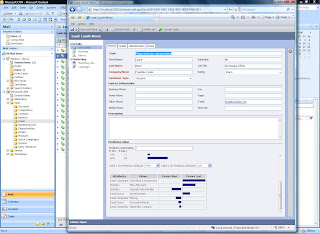
For more information goto http://www.microsoft.com/dynamics/crm/using/deploy/integratesharept.mspx
Thursday, August 2, 2007
Xcelsius dashboards
Crystal Xcelsius and Crystal Xcelsius Workgroup are the new standard in interactive data visualization software.
With Crystal Xcelsius, you can transform your complex data into visually stunning dashboards, financial calculators, forecast reports, and much more.
With Crystal Xcelsius, you can transform your complex data into visually stunning dashboards, financial calculators, forecast reports, and much more.
Link to the sample dashboard http://resources.businessobjects.com/support/cx/samples/download_45/ent_dashboard/enterprise_dashboard.swf

*Point-and-click ease. Crystal Xcelsius' intuitive interface, including pre-built components, skins, maps and charts, and one-click export, make it easy for non-technical users to develop business dashboards in less than an hour.
*Custom graphics and interactivity allow you to develop and present compelling yet easy-to-understand financial reports, sales forecasts reports, and more. All this can be done via the Web, MS Office, MS SharePoint, Adobe PDF, and any environment that supports Flash.
*Visual modeling. Sliders, gauges, filters, numerical input tools, and other visual components allow you to quickly evaluate multiple "what-if" scenarios in real-time, with the click of a mouse.
*Platform independence.
For more information goto -http://www.businessobjects.com/jump/crystalxcelsius/land/g_rightclick.asp?extcmp=xcel_google_xtm_Xcelsius
Wednesday, July 11, 2007
Populating CMDB - Discovery Solutions
Appilog (HP/Mercury)- Application Discovery and Mapping solution that ensures businesses can keep their applications available with minimal effort and cost.
Link - http://www.mercury.com/us/website/appilog.html
Collation (IBM ) - Collation software automatically captures information about IT resources, such as servers, applications and databases, and displays it on a detailed map.
Link - http://www-306.ibm.com/software/tivoli/features/collation/
Relicore (Symantec) - Relicore's Clarity product is configuration management solution capable of automatically discovering, mapping, and tracking changes to application and server components in real time.
Link - http://www.symantec.com/index.jsp
n-layers (EMC )- Automate CMDB Dependency Mapping using a unique, hybrid passive/active
discovery engine.
Link - http://www.nlayers.com/
Tideway (Tideway Systems) - Unique intelligent and agent-free discovery and reasoning engines,automatically populates the CMDB with information about the IT and application infrastructure and calculates the dependencies. Using normalization and reconciliation capabilities - data in third party configuration databases can be leveraged.
Link - http://www.tideway.com/
Cendura (CA)- IT service management and application service delivery solutions.
Link - http://www.ca.com/content/campaign.aspx?CID=137166
BMC Discovery (BMC)-automatically discovering People, Business Processes, Applications and IT infrastructure data to provide an up-to-date picture of your IT environment, the people who depend upon it, and the business processes that make up your critical business services.
Link - http://www.bmc.com/products/products_services_detail/0,,0_0_0_1701,00.html
Link - http://www.mercury.com/us/website/appilog.html
Collation (IBM ) - Collation software automatically captures information about IT resources, such as servers, applications and databases, and displays it on a detailed map.
Link - http://www-306.ibm.com/software/tivoli/features/collation/
Relicore (Symantec) - Relicore's Clarity product is configuration management solution capable of automatically discovering, mapping, and tracking changes to application and server components in real time.
Link - http://www.symantec.com/index.jsp
n-layers (EMC )- Automate CMDB Dependency Mapping using a unique, hybrid passive/active
discovery engine.
Link - http://www.nlayers.com/
Tideway (Tideway Systems) - Unique intelligent and agent-free discovery and reasoning engines,automatically populates the CMDB with information about the IT and application infrastructure and calculates the dependencies. Using normalization and reconciliation capabilities - data in third party configuration databases can be leveraged.
Link - http://www.tideway.com/
Cendura (CA)- IT service management and application service delivery solutions.
Link - http://www.ca.com/content/campaign.aspx?CID=137166
BMC Discovery (BMC)-automatically discovering People, Business Processes, Applications and IT infrastructure data to provide an up-to-date picture of your IT environment, the people who depend upon it, and the business processes that make up your critical business services.
Link - http://www.bmc.com/products/products_services_detail/0,,0_0_0_1701,00.html
Monday, June 25, 2007
Some good articles on Asset Management
The Evolution of IT Asset Management (part 1 of 4)
http://www.swspartners.com/newsletters/tlg-jun06.pdf
The Business Requirements and Design (part 2 of 4)
http://www.swspartners.com/newsletters/tlg-aug06.pdf
ITAM Data Capture and Data Store (part 3 of 4)
http://www.swspartners.com/newsletters/tlg-feb07.pdf
subscribe to the SWS newsletter - http://www.swspartners.com/newsletters/archives.html
http://www.swspartners.com/newsletters/tlg-jun06.pdf
The Business Requirements and Design (part 2 of 4)
http://www.swspartners.com/newsletters/tlg-aug06.pdf
ITAM Data Capture and Data Store (part 3 of 4)
http://www.swspartners.com/newsletters/tlg-feb07.pdf
subscribe to the SWS newsletter - http://www.swspartners.com/newsletters/archives.html
Wednesday, June 20, 2007
Forrester’s Definition Of A CMDB
Forrester defines a CMDB as a fundamental component of the information technology infrastructurelibrary (ITIL) framework that provides a unified repository of data about configuration items (CI) — any system component with configurable attributes — and describes the relationships between those CIs. From this, we can derive the main characteristics of a CMDB:
A CMDB is a repository of information about all configurable IT components. This repository should include all the physical, logical, and human elements used in the production of IT services.
A CMDB component has configuration attributes. Configuration attributes are all the parameters that determine the behavior of a component during production. They could be characterized as physical, logical, organizational, or financial.
A CMDB contains component relationships. The components are linked together to provide a service, and it is the service that links these components to the business process.The service may be as simple as an application, but it may also include several applicationsthat are logically grouped to provide a complete service to support the business process.
A CMDB is a fundamental component of the ITIL framework. All information recorded inthe CMDB exists solely to support the information technology service management (ITSM) processes described by ITIL. Therefore, a complete CMDB contains information dictated byITIL. Because its content is guided by ITIL, building a CMDB must start with the management process to the CI, the CI attributes, and its relationships to other CIs.
For more information on Forrester’s Definition Of A CMDB please refer to the following document -
http://www.bmc.com/USA/Corporate/attachments/TEI_CMDB_FINAL_Case_Study_to_BMC-USA_Version_12-27-06.pdf
A CMDB is a repository of information about all configurable IT components. This repository should include all the physical, logical, and human elements used in the production of IT services.
A CMDB component has configuration attributes. Configuration attributes are all the parameters that determine the behavior of a component during production. They could be characterized as physical, logical, organizational, or financial.
A CMDB contains component relationships. The components are linked together to provide a service, and it is the service that links these components to the business process.The service may be as simple as an application, but it may also include several applicationsthat are logically grouped to provide a complete service to support the business process.
A CMDB is a fundamental component of the ITIL framework. All information recorded inthe CMDB exists solely to support the information technology service management (ITSM) processes described by ITIL. Therefore, a complete CMDB contains information dictated byITIL. Because its content is guided by ITIL, building a CMDB must start with the management process to the CI, the CI attributes, and its relationships to other CIs.
For more information on Forrester’s Definition Of A CMDB please refer to the following document -
http://www.bmc.com/USA/Corporate/attachments/TEI_CMDB_FINAL_Case_Study_to_BMC-USA_Version_12-27-06.pdf
Thursday, June 14, 2007
Common 5 questions asked about CMDB
What is CMDB?
It provides visibility. Tells us what is in the IT infrastructure and How is it related with each other/ with critical business services?
In simpler terms it is database of CI’s and their relationship.
What is a CI?
CI is any device or application that we manage.
What is goal of CMDB in any organization?
The main goal of CMDB is to bring process together. – The ITIL Processes.
How is CMDB populated?
It depends on where is the information is stored. CMDB can have multiple resources. But the best way is to get a discovery tool populating the CMDB.
What should I store in CMDB, what attributes?
Interesting question – Answer it depends.
Try to start the CMDB with limited numbers of CI’s.
For attributes - you can refer to common information model on DMTF site. (http://www.dmtf.org/standards/cim/)
It provides visibility. Tells us what is in the IT infrastructure and How is it related with each other/ with critical business services?
In simpler terms it is database of CI’s and their relationship.
What is a CI?
CI is any device or application that we manage.
What is goal of CMDB in any organization?
The main goal of CMDB is to bring process together. – The ITIL Processes.
How is CMDB populated?
It depends on where is the information is stored. CMDB can have multiple resources. But the best way is to get a discovery tool populating the CMDB.
What should I store in CMDB, what attributes?
Interesting question – Answer it depends.
Try to start the CMDB with limited numbers of CI’s.
For attributes - you can refer to common information model on DMTF site. (http://www.dmtf.org/standards/cim/)
Tuesday, June 12, 2007
ITIL Service Management (ITSM) in a Nutshell

Service Delivery has five (5) Service Management processes associated with it:
-> Service Level Agreement Management (SLA, OLA)
-> Financial Management
-> Continuity Management
-> Availability Management
-> Capacity Management
Service Support has five (5) Service Management processes associated with it:
-> Incident Management
-> Problem Management
-> Change Management
-> Release Management
-> Configuration Management
Subscribe to:
Posts (Atom)


